Institutional investors leverage liquidity portfolios in a variety of ways across their business and investment operations. Despite differences in how various investors commit to liquidity strategies, they are all typically seeking to create stability in their portfolios.
Adequate liquidity can enhance operational planning, create a ready source of funding for expenses and commitments and help reduce volatility across various asset pools. Yet, liquidity portfolios can present investors with a conundrum.
Some investors lose sight of the value of liquidity when volatility is low, markets are stable and there is a clear line of sight towards sustained economic growth. The conundrum becomes apparent during times of market disruption when exogenous events create volatility and cause liquidity to dissipate.
When unexpected expenses arise or access to capital is constrained, organizations may face added strain as they work to sustain their missions. Prioritizing liquidity can help preserve access to funds and support more confident, informed investment decision-making.
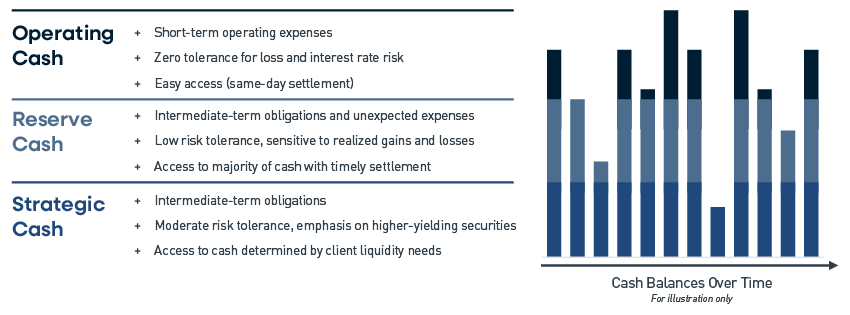
- Operational cash is cash needed for day-to-day activities and, in many cases, requires near same-day liquidity. A separately managed account (SMA) is not typically an ideal solution for operating cash pools unless cash needs are infrequent and highly predictable. In this space, bank deposit products and/or money market funds can be most valuable to investors.
- Reserve and Strategic cash allocations can introduce modest interest rate and credit exposure in pursuit of higher yields and total return, while maintaining alignment with investor objectives and investment policy statement requirements centered on capital preservation.
View Accessible Figure
A Client-Centered Approach to Liquidity
Each client's liquidity needs are shaped by their unique objectives, operating demands and risk considerations. A solutions‑based approach through SMAs can allow portfolios to be structured around those needs—balancing total return goals with appropriate attention to risk, liquidity and policy constraints.
Key Features of Separately Managed Accounts
- Ability to tailor to specific objectives: Align with the potential timing of cash flows and strategically position the portfolio on the yield curve
- Potential tax advantages: Control gain/loss recognition
- Direct ownership: Direct ownership of securities rather than being commingled with other investors in a larger pool
- Diversification: Across security types, sectors, sub-sectors and individual issuers
Through tailored portfolio construction, clients can align operating, reserve and strategic cash pools with their broader investment objectives, while ensuring portfolios remain disciplined, scalable and adaptable as organizational circumstances and market conditions evolve. A consultative process between an organization and the investment manager can help clarify cash allocation priorities and supports thoughtful investment policy design that reflects each client's unique requirements.
Accessible Figure
| Cash Category |
Characteristics |
| Operating |
- Short-term operating expenses
- Zero tolerance for loss and interest rate risk
- Easy access (same-day settlement)
|
| Strategic |
- Intermediate-term obligations and unexpected expenses
- Low risk tolerance, sensitive to realized gains and losses
- Access to majority of cash with timely settlement
|
| Reserve |
- Intermediate-term obligations
- Moderate risk tolerance, emphasis on higher-yielding securities
- Access to cash determined by client liquidity needs
|
Important Disclosures
This publication is for informational
purposes only. Information contained herein is believed to be accurate, but has
not been verified and cannot be guaranteed. Opinions represented are not
intended as an offer or solicitation with respect to the purchase or sale of
any security and are subject to change without notice. Statements in this
material should not be considered investment advice or a forecast or guarantee
of future results. To the extent specific securities are referenced herein,
they have been selected on an objective basis to illustrate the views expressed
in the commentary. Such references do not include all material information
about such securities, including risks, and are not intended to be
recommendations to take any action with respect to such securities. The
securities identified do not represent all of the securities purchased, sold or
recommended and it should not be assumed that any listed securities were or
will prove to be profitable. Past performance is no guarantee
of future results.
PNC Capital Advisors, LLC is a
wholly-owned subsidiary of PNC Bank, National Association, which is a Member
FDIC, and an indirect subsidiary of The PNC Financial Services Group, Inc.
serving institutional clients. PNC Capital Advisors' strategies and the
investment risks and advisory fees associated with each strategy can be found
within Part 2A of the firm's Form ADV.
PNC Capital Advisors, LLC claims
compliance with the Global Investment Performance Standards (GIPS®). A list of
composite descriptions for PNC Capital Advisors, LLC and/or a presentation that
complies with the GIPS® standards are available upon request.
Investments: Not FDIC Insured. No Bank
Guarantee. May Lose Value.
©2026 The PNC Financial Services Group,
Inc. All rights reserved.