On May 16, ahead of congressional negotiations over a hotly anticipated budget bill, Moody’s Ratings (Moody’s), stripped the United States government of its triple-A rating with a downgrade to Aa1, and changed the outlook to stable. Prior to the move, Moody’s had been the last of the three major credit rating agencies (alongside Standard & Poor’s and Fitch Ratings) to assign the U.S. its top rating. In our view, the downgrade was well telegraphed, given that, in late March, Moody’s noted that the government’s “fiscal strength [had] deteriorated further” since the agency first assigned a negative outlook back in November 2023.
In explaining the rationale behind their ratings action, Moody’s highlighted a more than decades-long deterioration in U.S. debt levels and service costs, alongside expected further increases in entitlement spending and limited improvements in revenue collection. Preliminary estimates suggest the extension of the Tax Cuts and Jobs Act will add approximately $4 trillion to the primary deficit over the next decade, pushing the projected debt burden-to-GDP ratio in excess of 130% during this period. Interest costs are forecast to approach 30% of government revenues by 2035, and have already eclipsed defense outlays on an annual basis.
While we expect the downgrade to have limited impacts on risk premiums, we view now as an opportune time to reflect on how markets have evolved since the April 2 “Liberation Day” tariff announcement. Broadly, equity markets have regained much of the ground lost in the first half of April; S&P 500® performance year-to-date is now approximately flat. Similarly, the initial spike in credit spreads across both investment grade and high yield has largely reversed; notably, high yield now has a modest, positive excess return year-to-date (YTD) due to greater carry.
The profiles of structured products, both agency mortgage-backed securities (MBS) and consumer asset-backed securities (ABS), have been less volatile (Figures 1 & 2); both have modest negative excess returns year-to-date. From a valuation perspective, investment grade credit is once again approaching the historically
most expensive decile based on our analysis of ICE indices. Meanwhile, higher quality MBS and ABS continue to offer more compelling relative value and merit consideration for overweight allocations in our managed strategies.
Figure 1. YTD Excess Returns (%)
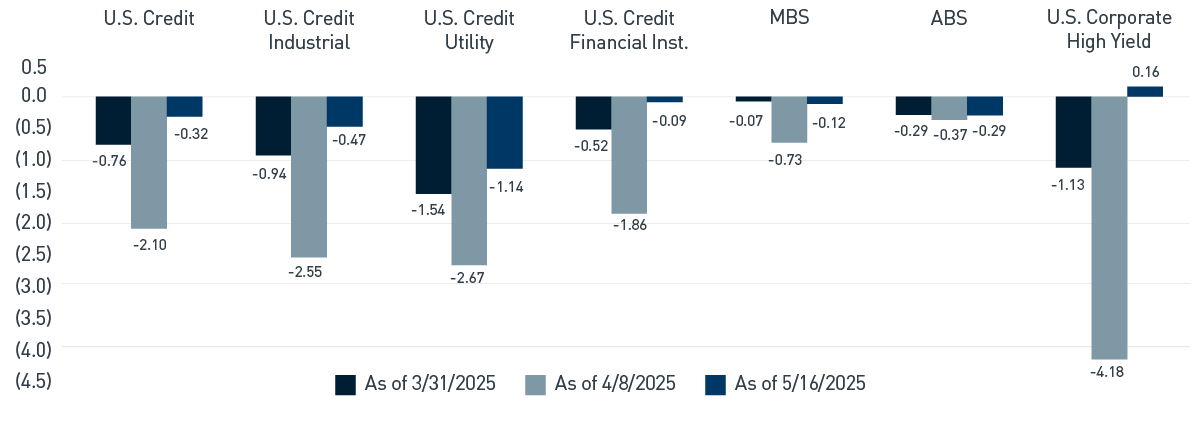
As of 5/16/2025. Source: Bloomberg L.P. View accessible version of chart.
Figure 2. YTD Option-adjusted Spread (bps)
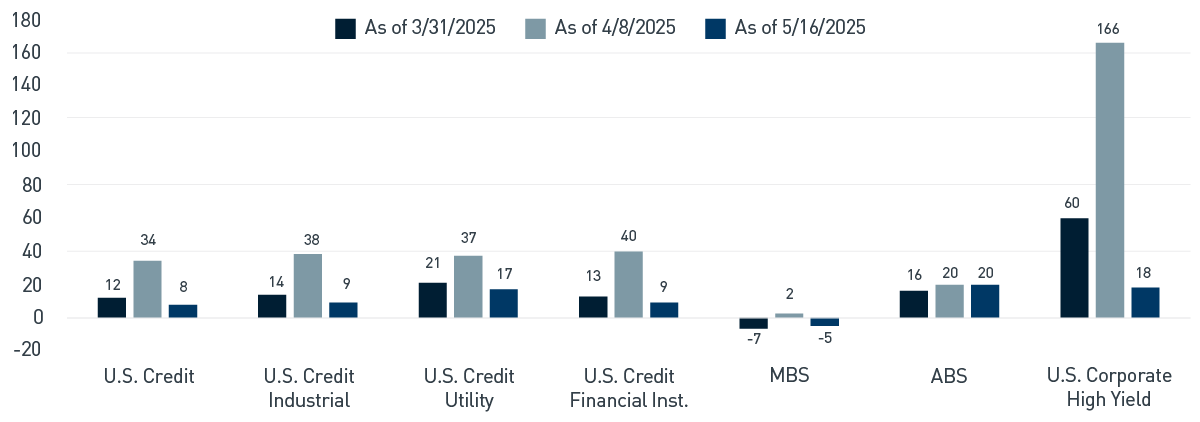
As of 5/16/2025. Source: Bloomberg L.P. View accessible version of chart.
Lean in to Carry and Roll
Amid lingering uncertainty about how tariffs will impact demand and prices, recent inflation and labor market data suggest the Federal Reserve (Fed)’s “wait and see” approach will continue for the foreseeable future. Market participants now expect two fed fund rate cuts later this year, and shorter-term yields have fallen year to date. At the same time, concerns about fiscal profligacy have pushed long bond yields higher and led to a steepening of the U.S. Treasury (UST) curve (Figure 3).
Figure 3. YTD Change in UST Yield Curve Spread (%)

As of 5/16/2025. Source: Bloomberg L.P. View accessible version of chart.
At the start of 2025, yields on many fixed income indices provided significant carry to cushion market value adjustments from rising rates. Broad intermediate benchmarks (including the Bloomberg Aggregate Index) have generated returns of approximately 2% year-to-date, besting cash. A steeper UST curve improves the roll dynamic within a fixed income portfolio, providing an additional source of potential total return as securities fall to lower yield points on the curve as they move towards maturity. Combined with a more diverse opportunity set, we believe longer-maturity fixed income allocations can provide ballast against higher risk-seeking portions of client portfolios.
Figure 1. YTD Excess Returns (%)
| Category |
As of 3/31/2025 |
As of 4/8/2025 |
As of 5/16/2025 |
| U.S. Credit |
-0.76 |
-2.10 |
-0.32 |
| U.S. Credit Industrial |
-0.94 |
-2.55 |
-0.47 |
| U.S. Credit Utility |
-1.54 |
-2.67 |
-1.14 |
| U.S. Credit Financial Inst. |
-0.52 |
-1.86 |
-0.09 |
| MBS |
-0.07 |
-0.73 |
-0.12 |
| ABS |
-0.29 |
-0.37 |
-0.29 |
| U.S. Corporate High Yield |
-1.13 |
-4.18 |
0.16 |
Figure 2. YTD Option-adjusted Spread (bps)
| Category |
As of 3/31/2025 |
As of 4/8/2025 |
As of 5/16/2025 |
| U.S. Credit |
12 |
34 |
8 |
| U.S. Credit Industrial |
14 |
38 |
9 |
| U.S. Credit Utility |
21 |
37 |
17 |
| U.S. Credit Financial Inst. |
13 |
40 |
9 |
| MBS |
-7 |
2 |
-5 |
| ABS |
16 |
20 |
20 |
| U.S. Corporate High Yield |
60 |
166 |
18 |
Figure 3. YTD Change in UST Yield Curve Spread (%)
| Date |
2-Year/10-Year |
5-Year/30-Year |
| 12/31/2024 |
0.00 |
0.00 |
| 1/31/2025 |
0.04 |
0.14 |
| 2/28/2025 |
-0.34 |
0.17 |
| 3/31/2025 |
-0.02 |
0.55 |
| 4/30/2025 |
0.71 |
1.38 |
| 5/16/2025 |
0.45 |
1.13 |
Important Disclosures
This publication is for informational purposes only. Information contained herein is believed to be accurate, but has not been verified and cannot be guaranteed. Opinions represented are not
intended as an offer or solicitation with respect to the purchase or sale of any security and are subject to change without notice. Statements in this material should not be considered investment advice or a forecast or guarantee of future results. To the extent specific securities are referenced herein, they have been selected on an objective basis to illustrate the views expressed
in the commentary. Such references do not include all material information about such securities, including risks, and are not intended to be recommendations to take any action with respect to such securities. The securities identified do not represent all of the securities purchased, sold or recommended and it should not be assumed that any listed securities were or will prove to be profitable. Past performance is no guarantee of future results.
Indices and/or Benchmarks Definitions
PNC Capital Advisors, LLC is a wholly-owned subsidiary of PNC Bank, National Association, which is a Member FDIC, and an indirect subsidiary of The PNC Financial Services Group, Inc. serving institutional clients. PNC Capital Advisors' strategies and the investment risks and advisory fees associated with each strategy can be found within Part 2A of the firm's Form ADV.
PNC Capital Advisors, LLC claims compliance with the Global Investment Performance Standards (GIPS®). A list of composite descriptions for PNC Capital Advisors, LLC and/or a presentation that complies with the GIPS® standards are available upon request.
Investments: Not FDIC Insured. No Bank Guarantee. May Lose Value.
©2025 The PNC Financial Services Group, Inc. All rights reserved.